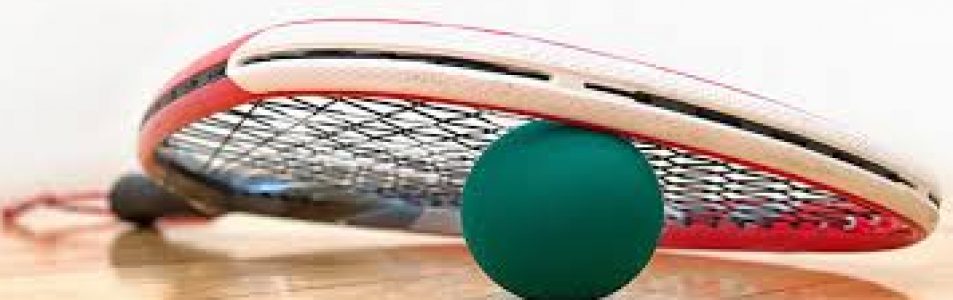
Playing a high energy sport like racquetball is a great way to keep weight down and maintain cardiovascular fitness. In the United States, we’ve seen an epidemic in recent years regarding how much weight the average adult gains each year. It’s hard to point to any one lifestyle choice as the culprit but being not getting enough exercise is one of the top three, along with poor eating and sleeping habits. Physical fitness guidelines from the President’s Council on Sports, Fitness & Nutrition (https://www.hhs.gov/fitness/be-active/physical-activity-guidelines-for-americans/index.html) suggest that adults who physically active lead heathier lives and are less likely to develop chronic diseases like heart disease, diabetes and stroke, than are there counterparts that are inactive. The recommendation from the Department of Health and Human Services (HSS) is for adults to get at least 150 minutes of moderate intensity exercise a week. If a person engaging in those types of activities, they will become even more fit and their risk of developing disease drops to lower levels. A study published in the British Journal of Sports Medicine looked at data from over 80,000 participants over a 9 year period and concluded that people that played racquet sports, like racquetball, squash and tennis, decreased their chances of dying by 47%. Could engaging in a racquet sport like racquetball be a strong component to keeping your body physically strong while keeping the body’s tendency to gain weight as we age, in check? I believe the answer is yes and I will provide solid data to backup that claim. First, let’s look at the physical side of racquetball and find out what this type of activity does for the body.
Why should you consider racquetball? There are many reasons to pick up the game of racquetball, according to the article “BALLS TO THE WALL” written by Mike Carlson (Carlson, Mike. Muscle & Performance, Oct 2012, Vol. 4 Issue 10, p24-24, 1p), players run around the court at top speed, chasing a small rubber ball that can reach speeds of over 165 miles per hour. All this running and stopping can be great for getting your body in shape, but is the game easy to learn? Mike says that racquetball is one of the simplest games to learn and that you can learn the skills you need to make the game enjoyable fairly quickly. Playing at a highly competitive level could take many years of drills and practice matches, but you’ll have lots of fun doing it. One thing I’ve learned when it comes to exercise, if you dread doing something you won’t stick with it long. It’s important to match yourself up with another player that’s relatively close to your skillset so the games are competitive. In addition to picking the game up quick, it can be inexpensive to get the gear you need for the game. In her article, “IS RACQUETBALL A GOOD WORKOUT?” (https://livewell.jillianmichaels.com/racquetball-good-workout-4724.html), Cindy Anderson states that you need four pieces of equipment needed for the sport, they are a racquet, safety goggles or glasses, court shoes and racquetballs. A quick search on Amazon (www.amazom.com) yielded a Python Series Beginners racquet for $21.57, Python Series Intro Eyewear for $8.99, Prince Men’s NFS Assault Indoor Court Sneaker Shoes for $32.99 and Penn Ballistic 2.0 Racquetballs for $4.29. So for around $68 plus sales tax you can get started with beginner equipment. As you progress you may want to upgrade your accessories and it will cost you a bit more as racquets can run into the hundreds of dollars.
The health benefits of playing racquetball are clearly laid out on the USA Racquetball website. Since there is so much movement in the game of racquetball you develop core strength as you swing to hit the racquetball from many positions. Quick twitch muscle fibers are created and honed due to the amount of starts and stops triggered during a game and this helps to improve a person’s agility and balance. Racquetball can be considered both an aerobic and an anaerobic activity. Aerobic because during each rally the heart rate increases causing the body to burn vast amounts of oxygen via respiration and as this happens the body burns fat quickly. Also, since games go to 21 points they can last 20 to 30 minutes, making it aerobic. On the other hand, there are many quick, hard bursts that make the body use an internal process called metabolization to burn the glycogen stored in muscles for energy, making it anaerobic. This is the same process used by the body when sprinting. Another health benefit is that since racquetball is a weight bearing exercise it strengthens the bones and muscles, helping you to maintain a healthy posture and even slowing bone loss as you age. Furthermore, cognitive functions that tend to decline with age may also improve. During a game of racquetball you must constantly make adjustments and adapt to new situations because the ball is moving around the court so fast. This repetitive type of activity will help to improve reaction times and quick decision making.
Most people today are concerned with their weight. Whether because they are overweight and need to lose a few pounds or because they are already at their ideal weight and want to stay there. We are constantly bombarded with commercials and magazine advertisements that tell us that we’re overweight and then tout the latest fad diet or we see endless pictures of some of the most fit people on the planet and are expected to look like them. However, science can help us out a bit here. The key to losing weight is to create a calorie deficit meaning that you burn more calories than you consume. If you can create just a 500 calorie imbalance per day, at the end of the week you’ll have lost around one pound since one pound of fat is equal to roughly 3,500 calories. A Harvard Medical School study showed that a 185 pound person playing competitive racquetball for an hour will burn close to 900 calories. That same 185 pound person will burn just over 600 calories per hour playing at a very casual rate. If you follow HHS’s guideline of 2 and a half hours of moderate intensity exercise, which racquetball surely is, and you played at a rate somewhere between casual and competitive, you’ll have burned an extra 1,875 calories which will equate to half a pound of fat burned. If you follow the recommendation of my earlier blog post “Health, Fun & Fitness” and played 4 and a half hours a week, you would be looking at a total of 3,375 calories burned or very slightly less than one pound a week. This, of course, assumes that your diet remains the same.
To wrap things up, I believe that the data supports my assertion that racquetball will help you get into to good shape while also providing the benefit of weight loss. There are many ways for us to get out and get fit, racquetball provides us with a way to do it and have fun at the same time. Now, pick up a racquet and get started!
Works Cited
“BALLS TO THE WALL.” Muscle & Performance, 1 October, 2012. http://web.a.ebscohost.com/ehost/pdfviewer/pdfviewer?vid=2&sid=0a7fd9d9-c04c-42e7-aadf-1c1ab4cfa6b7%40sdc-v-sessmgr03. Accessed 13 Oct. 2018
“Racquet Sports For A Longer Life.” NYTimes.com Video Collection, 7 Sept. 2017. Science In Context, http://link.galegroup.com/apps/doc/CT508082949/SCIC?u=cazc_main&sid=SCIC&xid=c6c05982. Accessed 13 Oct. 2018.
Cane, Patricia. “Courting Fitness” Diabetes Forecast, American Diabetes Association, Aug. 1990, http://diabetes.org/. Accessed 14 Oct. 2018
Holdorf, Candice. “Racquetball: Playing For a Lifetime of Physical, Mental and Financial Health” Health IQ, SEP. 2017, https://www.teamusa.org/USA-Racquetball/Features/2017/September/18/Playing-Racquetball-For-a-Lifetime-of-Physical-Mental-and-Financial-Health. Accessed 16 Oct. 2018
“Calories burned in 30 minutes for people of three different weights.” Harvard Health Publishing, Updated: August 13, 2018Published: July, 2004, https://www.health.harvard.edu/newsweek/Calories-burned-in-30-minutes-of-leisure-and-routine-activities.htm. Accessed 10 Oct. 2018

 Splat Racquetball Blog